| Moab, UT |
Eventually you reach the point in which you’ve run out of adjectives that can possibly do any sort of justice to the sights laid out before your eyes by Mother Nature.
Well my friends, I reached that point this afternoon at the Needles Overlook.
—–
In doing some research on the Utah National Parks prior to setting out on this journey, I’d come across a blog listing ten secret wonders of the state of Utah, and among those was Needles Overlook.
Unlike the more popular Island in the Sky, Needles was said to be far more remote, and thus far less crowded.
More remote and less crowded? In other words, right up my alley.
So I pinned it on Google Maps and in setting up the next day’s agenda in my hotel that night, figured I’d be able to hit it up after a possible quick tour of Arches.
Possible being the key word.
Possible because Arches National Park is right outside Moab, UT; and Moab, UT, as I’d suspected prior, and confirmed upon hitting town is the quintessential tourist trap.
And as such, is very, very crowded.
——
Moab is in South Central Utah and like a good deal of the rest of the state, is a long ways from any other group of buildings, that would colloquially be known as a town.
So if you’re headed to Moab, it’s likely that you, like me, are headed to one of the two National Parks nearby, Arches and Canyonlands.
And in order to get there, you’re driving a ways – and if you’re smart, you better have a pretty full gas tank, because opportunities to fill up are going to be few and far between. I myself set out from Price, UT and only passed one other town on the two hour trip.
As has almost exclusively been the case, the drive to town was magnificent. Many of the ways that I’ve talked of prior hold true here as well.
Nothing but you, a few other cars, ribbon after ribbon of highway, and extraordinary sights out your windows in all directions.
In this case red cliffs, hills and mountains in seemingly endless perpetuity.
Note: A couple of you asked if photos I’ve been posting from the area are digitally colored. They’re not. I have thrown on some filters, but those are just to adjust for sharpness and the like. Those rocks really are the magnificent hues of red, pink, vermillion, etc.
Here’s a pretty good description, borrowed from another website, as to why.
In many of Southern Utah’s rock formations, the sand or mud is cemented together with hematite – a rusty red iron oxide mineral – and limonite – a yellow iron oxide mineral.
Take, for instance, the Navajo sandstone that makes up the sheer cliffs of ZionNational Park. During the Jurassic Period – about 180 million years ago – this area was covered by a vast desert. Some of the sand may have been red at the time from the iron mineral (geologists can’t be sure, there are no photos from that time) but it is more likely the sand was your typical tan color.
Those sand grains haven’t changed color. If you look at a piece of Navajo sandstone under a microscope, the grains themselves are still white, gray or tan, but the grains are completely coated with the hematite cement, giving the appearance that the rock is totally red.
But eventually you come upon Moab itself and quickly discover that there’s not much to it but a main drag of hotels, a few restaurants and everything else needed to cater to the multitudes of tourists.
Many are your typical amenities, such as all the popular chain hotels.
But what sets Moab apart, at least for me, are the more specifically catered, such as helicopter tours, jeep rentals and most uniquely Moab’ish, dune buggy rentals.
So upon coming into town you have a good queue of traffic going down the main drag including every form of camper known to man. Interspersed in between you’ve got the odd square pegged roaring dune buggy, or comically big wheeled Jeep, driven by someone with….let’s just say a sense of reckless abandon.
It definitely reminded me of Springdale, UT (outside of Zion), and also Sedona, AZ as well.
Nothing wrong with any of these places, and certainly not trying to rag on any of the great people I’ve met there, the towns just aren’t my idea of a good time.
I prefer less crowds, less chain restaurants, and less overall ‘Disneyfication’.
—–
So the next morning, I figured I’d try to hit up Arches and if that failed, I’d move onto Canyonlands.
Arches is by far the more popular of the two, probably because it’s only a couple miles outside town, while Canyonlands is a bit of a drive.
So I got up at normal time, finished off my morning routine, packed up, drove over to Arches about 9:30am and…
Turned right around and drove away.
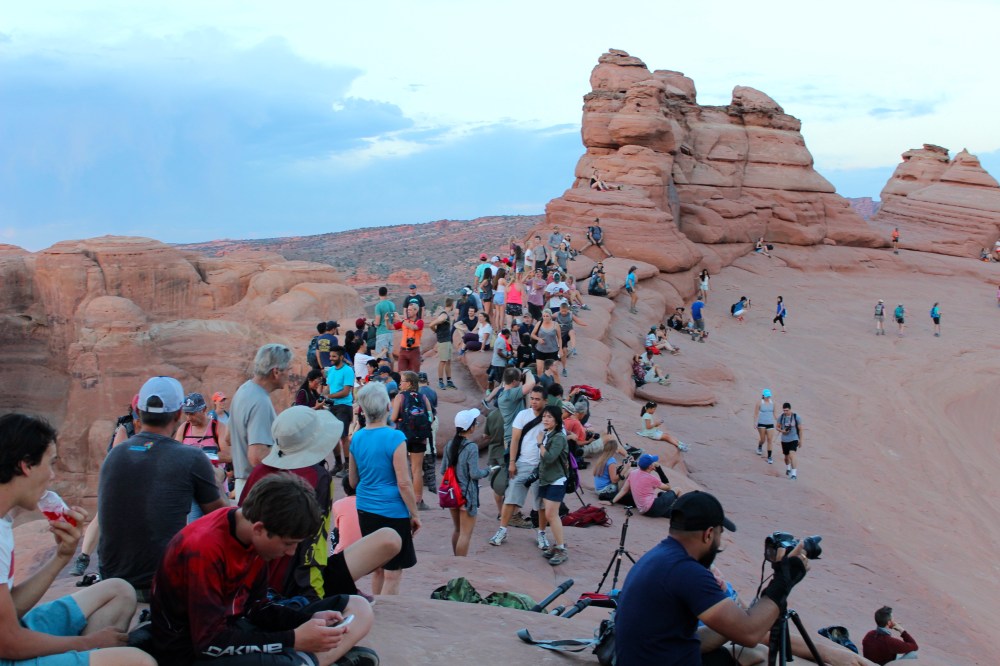
I’d read you need to get there early if you wish to avoid the crowds, and as I’d suspected, I wasn’t nearly early enough. For the lines at the entrance were at least fifty cars / trucks / campers deep, times three lanes. No thanks.
Unlike my attitude in real-life, I’ve taken a fairly laissez-faire attitude to these things during this trip.
If I got there great, if not, there’s a dozen more options down the road.
It’s a liberating mindset, one likely difficult to replicate at home but one that’s refreshing, and that I aim to at least try to continue upon re-entering real-life.
And so down the road I went.
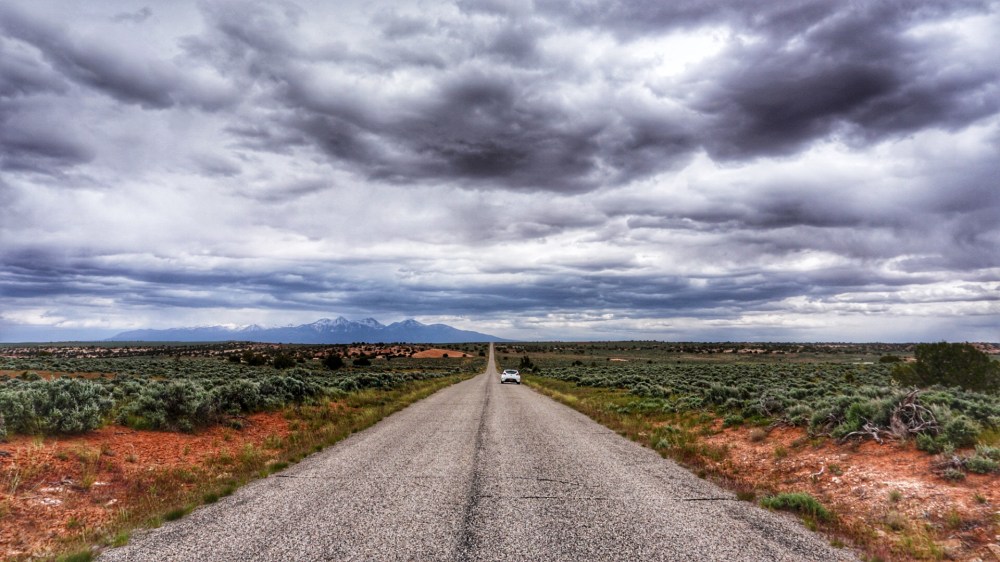
As mentioned before, the overlook is remote.
Roughly 33 miles of highway to the entrance road and another 22 miles or so down a two lane road of nothing to get to your destination.
Which if asked is exactly how I’d describe the way to get there, with one minor postscript….
Open your eyes, open your mind, open your throttle and enjoy.
And that I did.
I passed a handful of cars going in the opposite direction on the way in, and only two going my way, so I wasn’t at all surprised to see only three other vehicles parked at the overlook.
From the pictures online, I thought I had a decent idea what to expect; especially since I had got a couple of very brief peeks through the shrubs and low-laying trees as I got within a couple of miles of the lot.
Well I didn’t.
As stated at the beginning of this article, I really can’t think of a way to do justice in describing the view.
Other than to say, it’s the most beautiful thing I think I’ve ever seen; and I’m really not being hyperbolic folks.
It’s was truly beyond description.
The Colorado River has been hard at work in creating this masterpiece for somewhere in the neighborhood of 250 million years and I was left feeling very, very fortunate for that hard work.
Graciously I’ve now added it to my repertoire of memories on this trip.
I have no doubt that it’s such a memory that I’ll hold onto for however long I may be fortunate enough to live.
Enjoy.
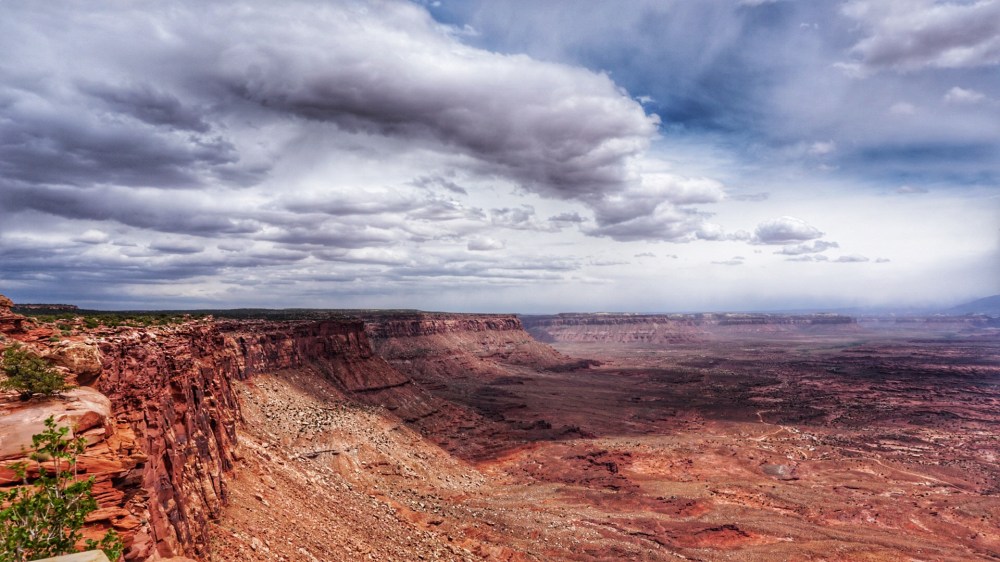
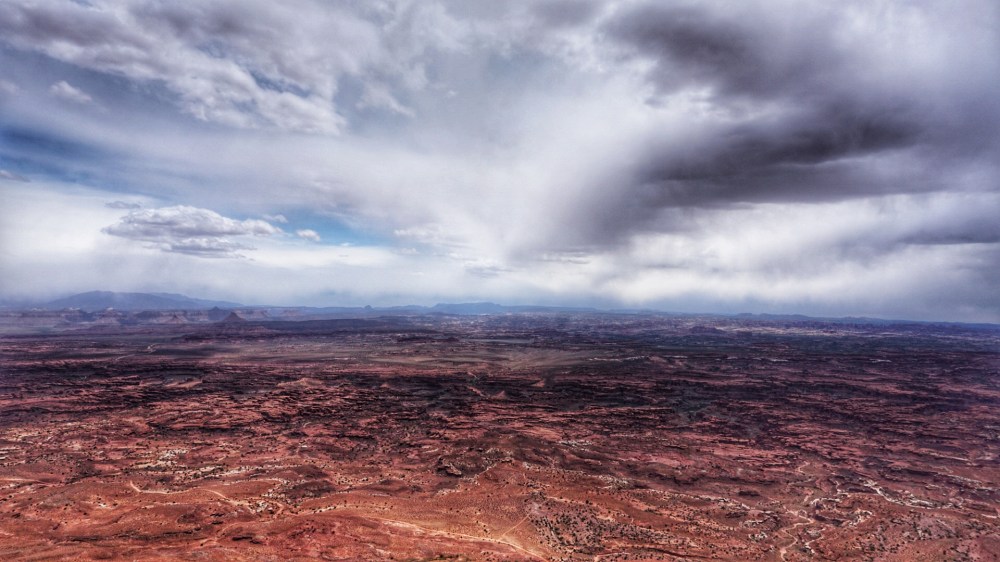
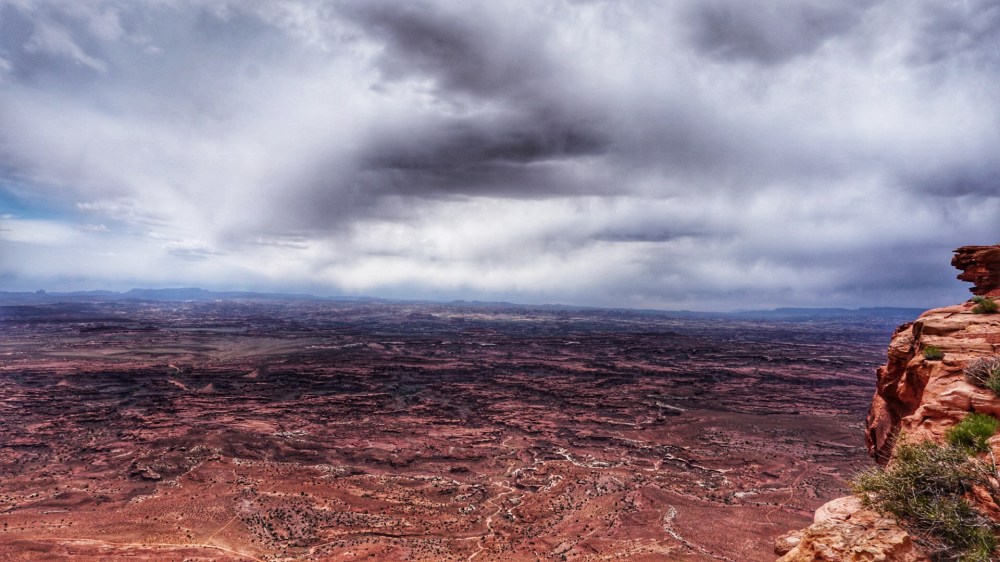
Note: These three photos represent the whole view of the crater, left to right, as a panorama won’t view properly in the blog. I posted the panorama’s in the galleries section.
 The Long Road